

On 1 December 2025, the Copernicus Thematic Workshop on Water brought together experts, policymakers, and industry representatives in Brussels and online to discuss how Earth Observation (EO) data can support sustainable water management across Europe. The workshop highlighted the essential role of Copernicus in providing accurate, timely, and comprehensive information for water monitoring, policy reporting, and decision-making.
Building on the success of the 2018 edition, the workshop showcased recent advances in Copernicus services and their contributions to the Water Framework Directive (WFD), flood and drought management, and climate adaptation strategies; topics very relevant for the objectives of the CENTAUR Horizon Europe project.
Co-organised by the European Commission’s Directorate-General for Defence Industry and Space (DG DEFIS), the Directorate General for the Environment (DG ENV), and the EU Agency for the Space Programme (EUSPA). The event welcomed more than 70 participants in person and nearly 200 online, including representatives from the Joint Research Centre (JRC), the European Environment Agency (EEA), and the European Space Agency (ESA).
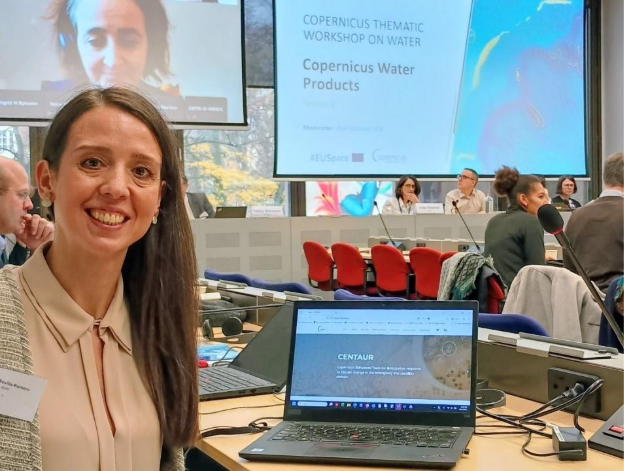
CENTAUR was represented on site by Beatriz Revilla-Romero, Senior Flood Risk Expert and Project Manager at GMV, and by other consortium partners representatives from UNISTRA-SERTIT and ECMWF who contributed online.
Discussions underlined that effective water management relies on both long-term trend information and accurate geospatial data to support policy development. Participants noted that a gap remains between Copernicus Services and the indicators needed to monitor the implementation of the WFD, suggesting room for improvement.
During the dedicated session on user needs it was emphasised the importance of near real-time information for risk management, together with the integration of EO, in situ, and national data to address fragmented datasets. The discussion further noted that digital tools and Geographic Information Systems (GIS) can simplify administrative processes, in line with the EU Nature Restoration Regulation.
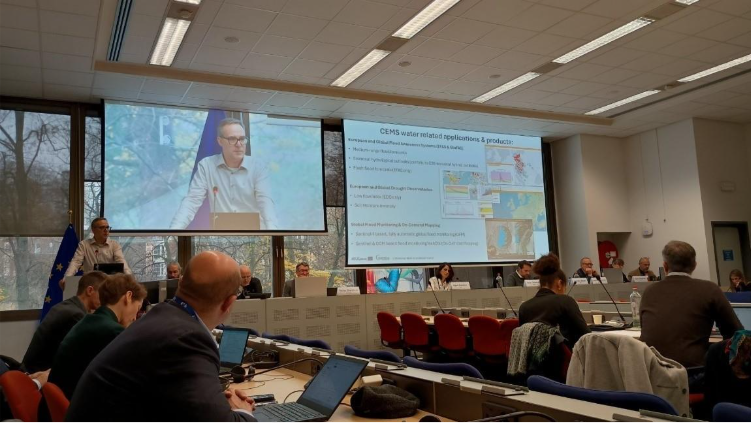
Peter Salamon, Coordinator of the Copernicus Emergency Management Service (CEMS), presenting CEMS portfolio of water-related products spanning from flood and drought forecasting, to monitoring, and emergency mapping.
In addition, it was announced that insights from the reports of the EU Water Resilience Research & Innovation projects under Horizon2020 and Horizon Europe will be presented during the 1st Water Resilience Forum in Brussels on 8 December 2025, in which discussions on strengthening Europe’s water resilience will continue. Furthermore, the European Commission’s Water Hub, expected to be launched in 2026, will serve as a single access point for Copernicus water products, providing a single access point for local and national administrations.
By actively engaging in initiatives like this workshop, the CENTAUR project team stays aligned with user needs and contributes to improving Copernicus Services, helping Europe address water challenges and build climate resilience.
To stay updated on CENTAUR’s progress and activities, follow us on LinkedIn, X, and BlueSky, and subscribe to our Project Updates.