

Throughout 2025, the CENTAUR project team delivered substantial progress, strengthening its ability to support preparedness, anticipation, and informed decision-making in the context of climate-related crises. Over the course of the year, the project advanced the operationalisation of integrated indicators and analytical workflows, translating climate hazards and socio-economic factors into timely, actionable insights.
In April, CENTAUR held a joint milestone event to present the outcomes of the Demo Review for Cold Cases (DR-CC). During this event, both the results of the cold case analyses and the Preliminary Demonstration and Review Exercise (PDRE) were presented. More than 250 datasets, covering 37 indicators, were processed and evaluated, informing the refinement of ongoing indicator development. The consortium also presented the results of the Valencia cold–hot case and discussed key new developments related to the hot cases. These activities included validation exercises and structured feedback from end users. In particular, the notification and alert system was introduced as a major step in strengthening the platform’s anticipatory capabilities.
Following the Demo Review, a key development highlighting this progress was the finalisation of the workflow for producing socio-economic indicators that support integrated analyses of drought, food insecurity, and their knock-on effects on conflict and displacement. These indicators are now automatically updated on a weekly basis, ensuring they remain continuously refreshed and ready to inform analyses and decision-support outputs.
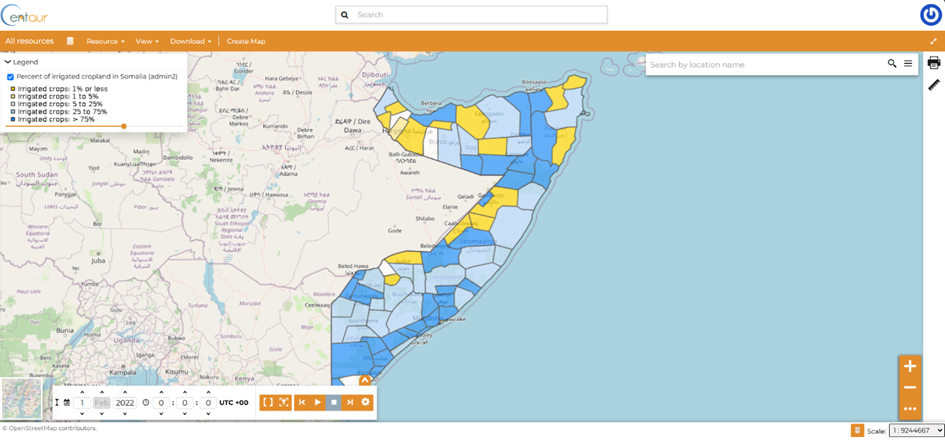
Example from the CENTAUR platform illustrating the percentage of irrigated cropland for the Somalia use case.
In parallel, the consortium developed and deployed a workflow for the on-demand production of socio-economic indicators focused on vulnerability and resilience to floods in urban areas. This workflow delivers high-resolution assessments of the distribution of financial resources, access to essential services, and potential evacuation constraints in urban settings, thereby augmenting CENTAUR’s capacity for anticipatory risk assessment across multi-hazard environments. A significant milestone was the successful implementation of a full hot case, focusing on a real flood event in the Milan province.
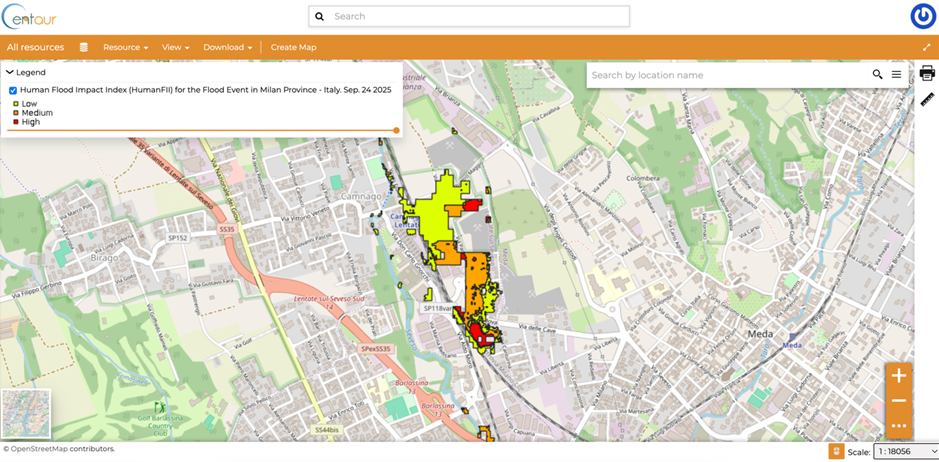
Example from the CENTAUR platform illustrating the application of the Human Flood Impact Index (HumanFII) during a flood event in Milan province in September 2025.
In 2025, the project also developed a methodology to weight different biophysical and socio-economic drivers of climate security risk, drawing on expert surveys. This methodology supports the structured integration of multiple drivers within CENTAUR analyses and contributes to the development of climate-security indicators.
These advances, alongside many others, fed into the Final Demo Review (FDR) meeting held in November 2025, which marked a major milestone and the culmination of CENTAUR’s demonstration activities. During this meeting, consortium partners and Advisory Board members reviewed the final configuration of CENTAUR indicators and platform capabilities, including updated early warning indices such as the Flood Early Warning Index (FEWI), Flood Impact Index (FII), and the Drought Conflict Prediction Index (DCPI).
A central focus of the review was the formal demonstration of the alert system. Previously announced during the joint DR-CC/PDRE milestone, the alert system was presented in its final operational configuration at the Final Demo Review (FDR). It was demonstrated as a key component for enhancing situational awareness, enabling users to receive early-warning notifications tailored to their preferences, selected hazards, geographic areas, and indicators of interest.
The review also summarised outcomes from recently completed hot-case analyses and confirmed the readiness of both the alert system and the overall platform for sustained operational use beyond the project timeline.
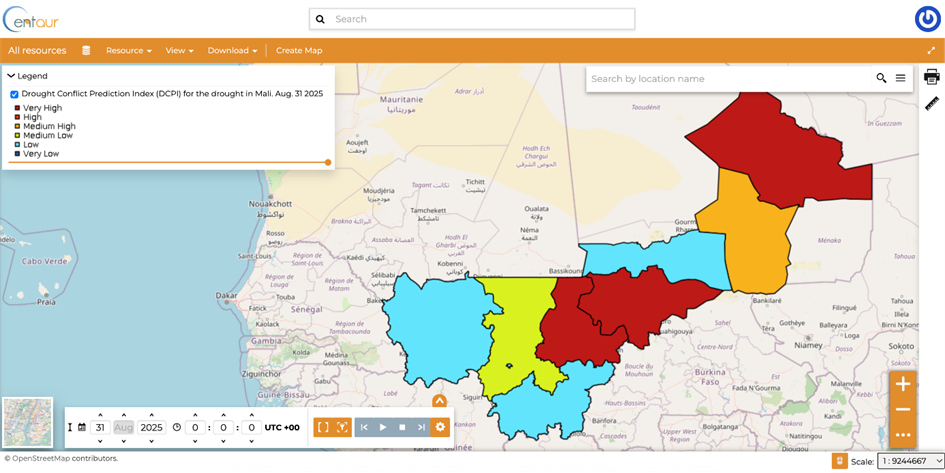
Example from the CENTAUR platform illustrating the application of the Drought Conflict Prediction Index (DCPI) in Mali.
CENTAUR engagements during 2025
In 2025, CENTAUR representatives actively engaged with scientific communities, policy actors, and public- and private-sector stakeholders to share project results, exchange expertise, and gather feedback on climate security early warning needs.
At the Annual Meeting of the European Meteorological Society (EMS) 2025 in Ljubljana, partners from the European Centre for Medium-Range Weather Forecasts (ECMWF) presented CENTAUR extreme precipitation forecasting products designed to anticipate urban flooding. These products were shortlisted among the three finalists for the Harry Otten Prize 2025 for innovation in meteorology, highlighting their scientific quality and operational relevance.
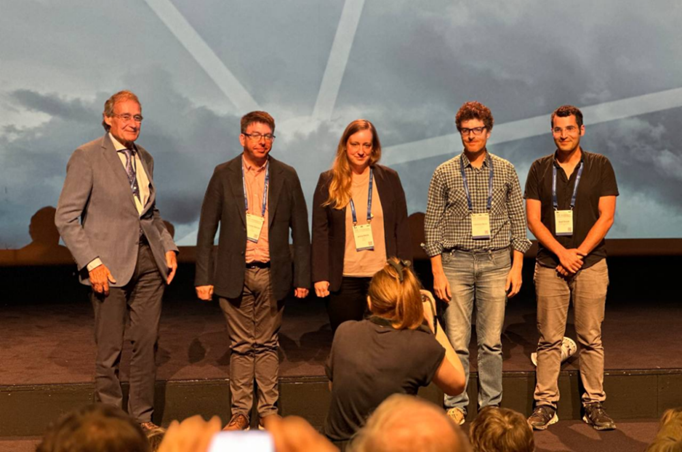
Chris Barnard (second from left), and Jessica Keune (third from left), representing ECMWF and CENTAUR at the Harry Otten Prize Session held within the European Meteorological Society Annual Meeting 2025. Credit: Siham El Garroussi.
CENTAUR also took part in the EU Science for Preparedness Conference in Turin in November 2025, where project representatives presented a poster showcasing CENTAUR’s integrated approach to climate security early warning. The presentation attracted strong interest from civil protection authorities and disaster risk management practitioners, fostering exchange on methods to monitor vulnerability, resilience, and cascading risks.
Likewise, CENTAUR was actively involved in several major scientific and policy events. For instance, the team displayed its tools and research at the Copernicus webinar for Land, Agriculture and Food Security in Africa, as well as at the European Geosciences Union General Assembly and ESA’s Living Planet Symposium in Vienna.
Further important contributions were made at ITAIS 2025 and the EOTEC DevNet regional meet-up. These outreach and conference activities significantly broadened CENTAUR’s visibility and facilitated engagement with the climate resilience community. These activities also provided opportunities to discuss how integrated climate-security indicators and early warning tools can support preparedness and preventive action.
A full overview of events and outreach activities involving CENTAUR in 2025 is available here.
As CENTAUR approaches project completion, the advancements made in 2025 – such as operationalising indicator workflows, developing innovative methodologies, demonstrating platform capabilities, and engaging extensively with stakeholders – represent a significant milestone in the project’s implementation.
To stay updated on CENTAUR’s progress and activities, follow us on LinkedIn, X, and BlueSky, and subscribe to our Project Updates.