

On 25 February 2026, the second and final CENTAUR workshop was held in Brussels at the Health and Digital Executive Agency (HaDEA) in a hybrid format. The event brought together more than 100 participants, both on-site and online, and marked a major milestone for the project: the culmination of three years of research and development activities at the intersection of Earth Observation (EO) and Artificial Intelligence (AI).
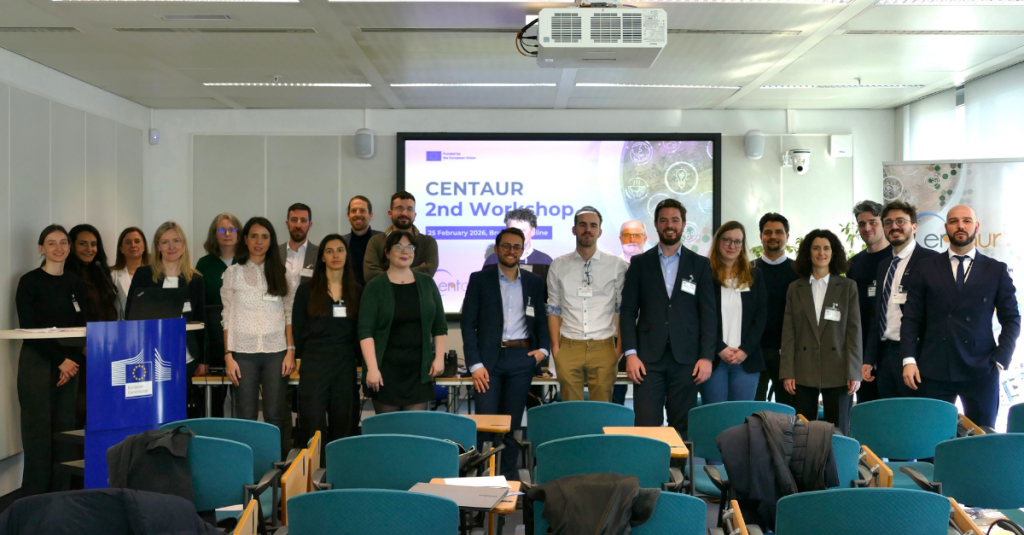
Bringing together representatives from EU institutions, international organisations, entrusted agencies, research organisations, industry, operational stakeholders, and fellow Horizon Europe projects, the workshop assessed CENTAUR’s results and their relevance for the evolution of the Copernicus Emergency Management Service (CEMS) and the Copernicus Security Service on Support to EU External and Security Actions (SESA).
The CENTAUR 2nd Workshop opened with an institutional framing session, followed by an open panel discussion on the use of EO and AI for early warning, and concluded with a CENTAUR overview and live platform demonstration.
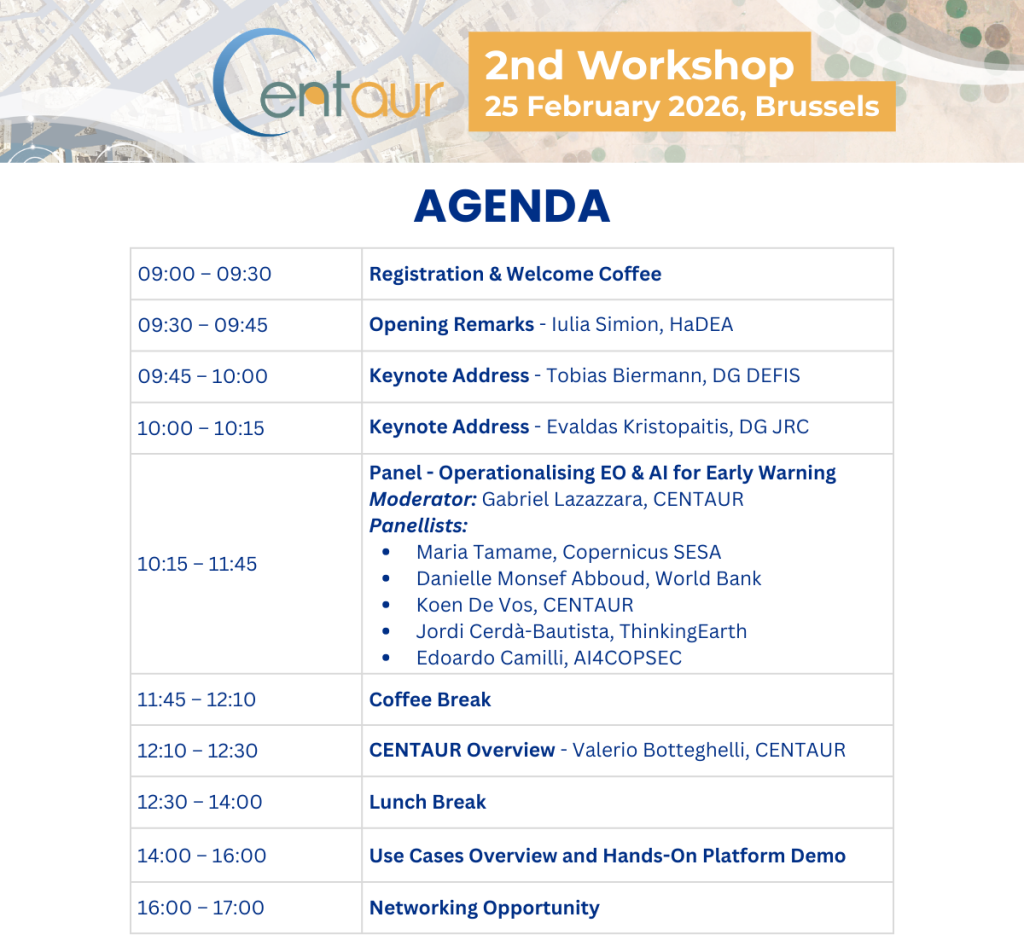
The Strategic Institutional Framework
Iulia Simion, Project Adviser at the Space Research Unit of the European Commission’s Health and Digital Executive Agency (HaDEA), introduced the session with an overview of HaDEA’s R&D portfolio supporting the evolution of Copernicus Security and Emergency services, highlighting how Horizon Europe projects contribute to strengthening operational capabilities.
She was followed by Tobias Biermann, Policy Officer at the European Commission’s Directorate-General for Defence Industry and Space (DG DEFIS), who addressed the broader trajectory of Copernicus, outlining ongoing developments within CEMS and SESA and stressing the importance of transitioning validated research results into sustainable operational service components.
The institutional framing was completed by Evaldas Krištopaitis, Project Officer at the Joint Research Centre (JRC), who emphasised the central role of the Earth Observation Strategic Research and Innovation Agenda (SRIA) in aligning research investments with future operational and policy needs.
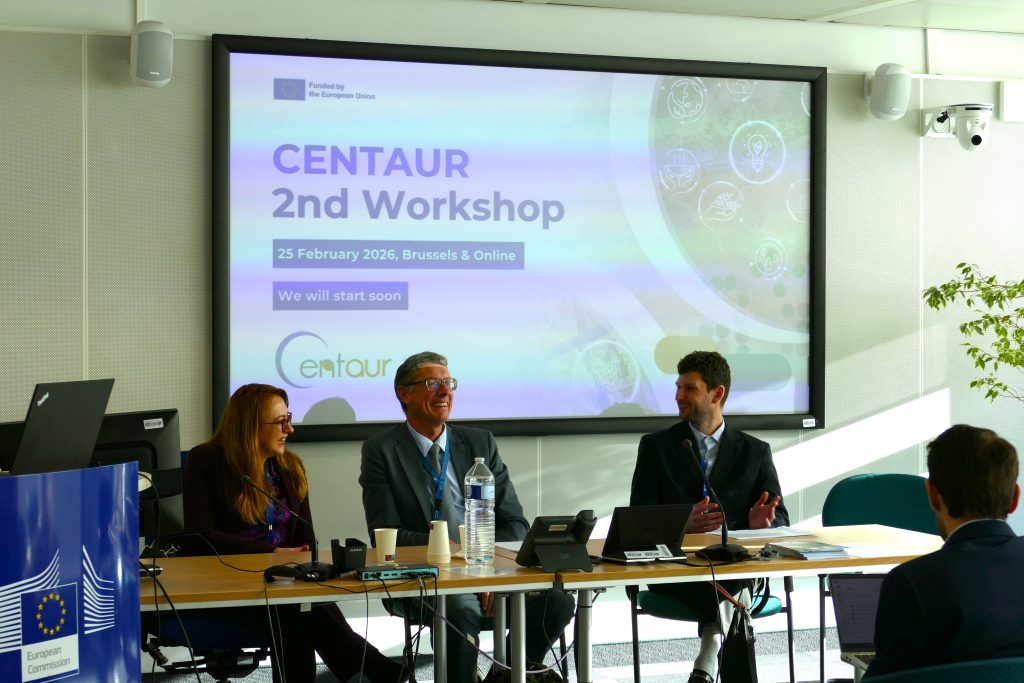
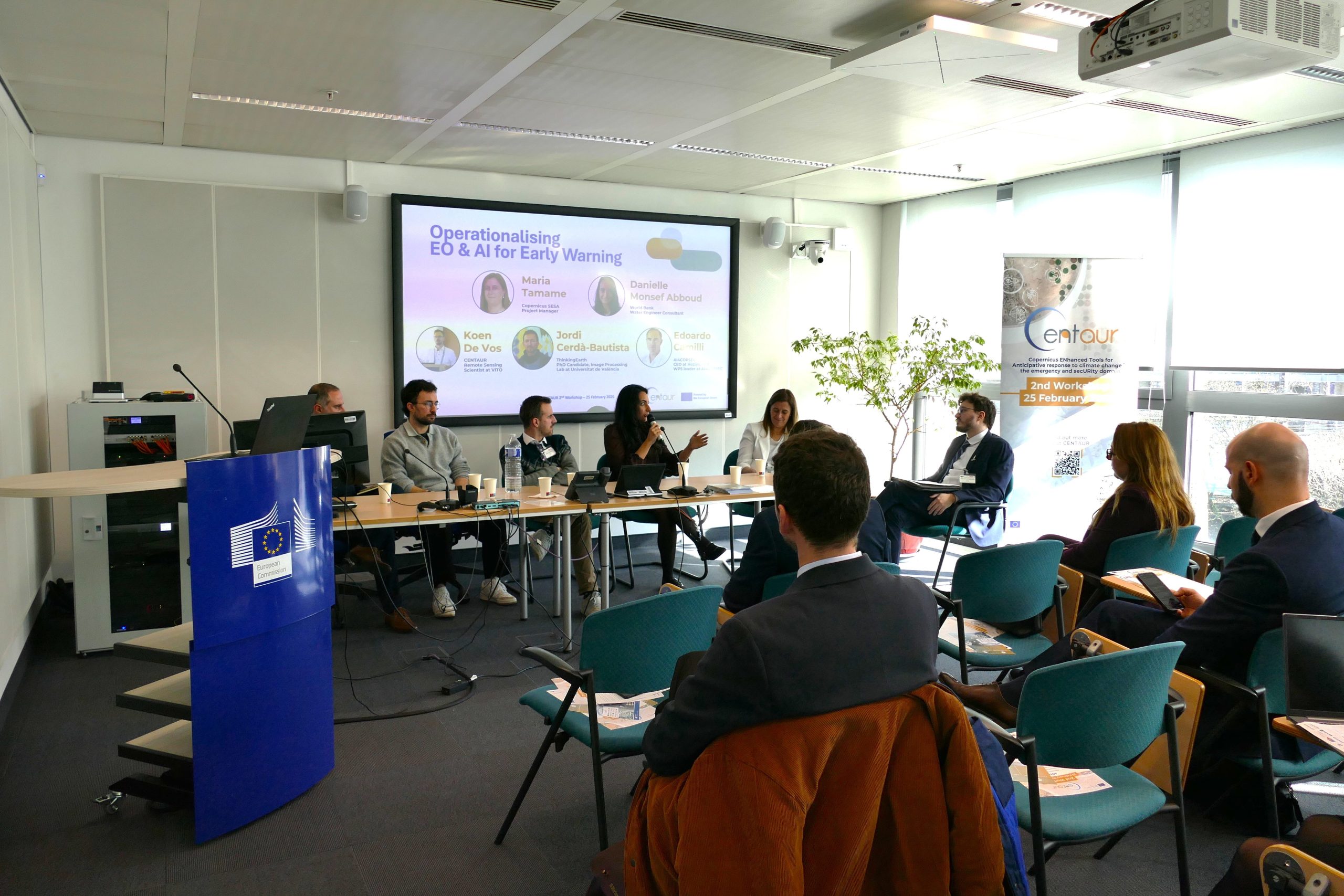
Operationalising EO & AI for Early Warning
The panel brought together five experts to discuss different perspectives:
- Maria Tamame, Project Manager for Copernicus SESA at the EU Satellite Centre (SatCen), outlined the evolution of SESA, and the operational integration challenges associated with transitioning research into operations. She emphasised that structured transition mechanisms are essential to transform research outcomes into fully operational Copernicus capabilities, noting that early involvement of operational users, structured validation processes, and dedicated service evolution pathways are key to maximising the impact of research. Maria also reflected on CENTAUR’s next steps, stressing how these approaches can ensure that innovative EO and AI solutions are effectively adopted and sustainably integrated into operational workflows.
- Danielle Monsef Abboud, Water Engineer Consultant at the World Bank, presented a compelling use case on flood extent estimation and hazard exposure in South Sudan, illustrating how EO supported decision-making across the World Bank project cycle. The presentation highlighted the increasing need for reliable, timely data, and showed how their platform has already played a crucial role in managing these crises by providing actionable insights and guiding response efforts.
- Koen De Vos, Remote Sensing Scientist at VITO and member of the CENTAUR consortium, detailed the work performed by the project team in developing the Agricultural Drought Forecasting index, explaining how EO data and forecasting methodologies were integrated in a pre-operational setting.
- Jordi Cerdà-Bautista, PhD Candidate at the Image Processing Lab, Universitat de València, presented results from the ThinkingEarth Horizon Europe project, which uses deep learning, causality, explainable AI, and physics-aware machine learning, to exploit the availability of Copernicus free and open data. He focused in particular on their Use Case: Causality for Food Security under Climate Change, which demonstrates how causal inference methods are applied to estimate the impact of key drivers on food security.
- Edoardo Camilli, CEO of Hozint and WP5 Leader at AI4COPSEC Horizon Europe Project, shared insights on their work on AI-driven maritime and border surveillance. AI4COPSEC combines AI, Copernicus data, geomatics, and social media data to improve maritime monitoring and environmental crisis response.
The discussion highlighted the growing potential of EO and AI solutions while stressing key challenges in governance, data validation, interoperability, and operational adoption. Success depends on aligning end-user expectations with the coordinated efforts of research, industry, and institutions to achieve effective and sustainable integration.
Although AI-powered climate-security services provide important early warning functions, connecting hazard-specific details and historical information with risks like conflicts and humanitarian crises, and aiding in regional analysis ahead of time, their implementation into real-world operations remains difficult. Many solutions remain at the prototype or pre-operational stage and require extensive adaptation, validation, and secure integration within institutional infrastructures. Key hurdles include clarifying dependencies, ownership, and access to processing chains, while ensuring compliance with security requirements. The discussion in the panel underscored how important ongoing efforts are to explore feasible and simplified pathways to bridge these gaps and move toward a faster operational deployment of Horizon Europe projects results.
All the slides presented during the event are available at the bottom of the page.
Hands-on Demonstration of the CENTAUR Platform
The following sessions shifted from the broader perspective on EO and AI applications to CENTAUR. Participants received a comprehensive overview of CENTAUR’s development and results, and attended a hands-on demonstration of the platform’s capabilities.
CENTAUR’s innovation lies in transforming large EO data streams into actionable early-warning indicators and indexes addressing two domain areas:
– Urban Floods (UF)
– Water and Food Insecurity (WFS)
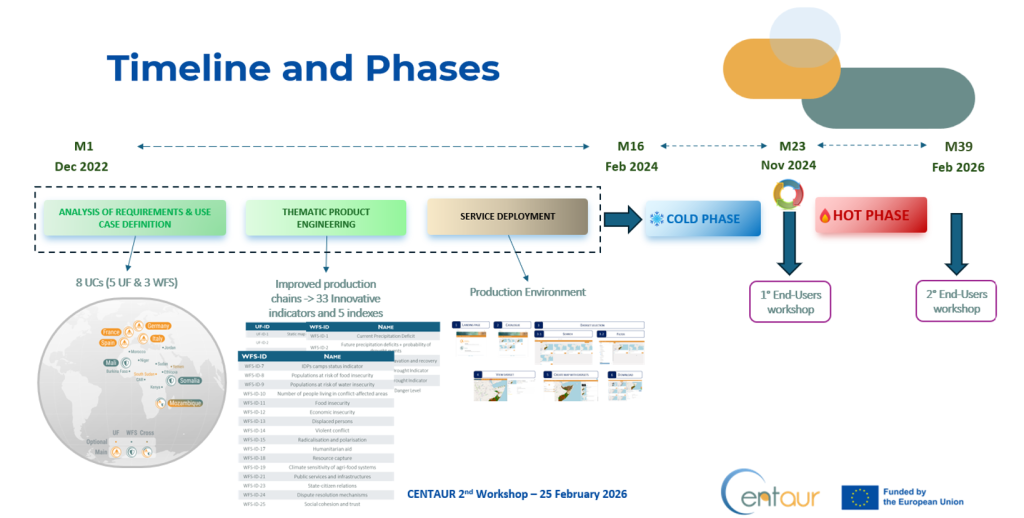
The overview also provided a comprehensive examination of all use cases developed for UF and WFS, along with the corresponding indicators and indexes designed, validated, and refined over the course of the project.
This represented an opportunity to consolidate and review the project’s key achievements:
- Development of 33 innovative indicators and 5 composite indexes across Urban Floods and Water and Food Security domains
- Implementation of an integrated early warning architecture operating in continuous and event-driven modes
- Demonstrated added value for Copernicus EMS and Copernicus SESA services
- Integration of all components into a pre-operational production environment with alert logic and product catalogue
Looking Ahead
The CENTAUR’s second workshop did not represent just a closing moment but rather an important consolidation step. It provided an opportunity to present validated results, and gather further feedback from institutional and operational stakeholders.
The discussions in Brussels reinforced the shared commitment to continue positioning CENTAUR’s tools and indexes within the broader Copernicus ecosystem, ensuring that the work carried out over the past three years can effectively support the future evolution of Europe’s early warning capabilities in relation to disaster management and climate security.
A heartfelt thank you is extended to all the speakers and participants for their contributions during the workshop.
Workshop Presentations:
- Iulia Simion – HaDEA: Portfolio of R&D projects related to Copernicus Security and Emergency services evolution
- Tobias Biermann – DG DEFIS: Copernicus Evolution
- Evaldas Krištopaitis – JRC: From Strategy to Impact: Shaping European EO Innovation
- Maria Tamame – Copernicus SESA: From Research to Operations: the Copernicus SESA Perspective
- Danielle Monsef Abboud – World Bank: a Perspective on Operationalising
EO & AI for Early Warning - Koen De Vos – CENTAUR: Agricultural Drought Forecasting
- Jordi Cerdà-Bautista – ThinkingEarth: Causality for food security under Climate Change
- Edoardo Camilli – AI4COPSEC: Project overview
- Valerio Botteghelli – CENTAUR: Project Overview
To stay updated on CENTAUR’s progress and activities, follow us on LinkedIn, X, and BlueSky, and subscribe to our Project Updates.